
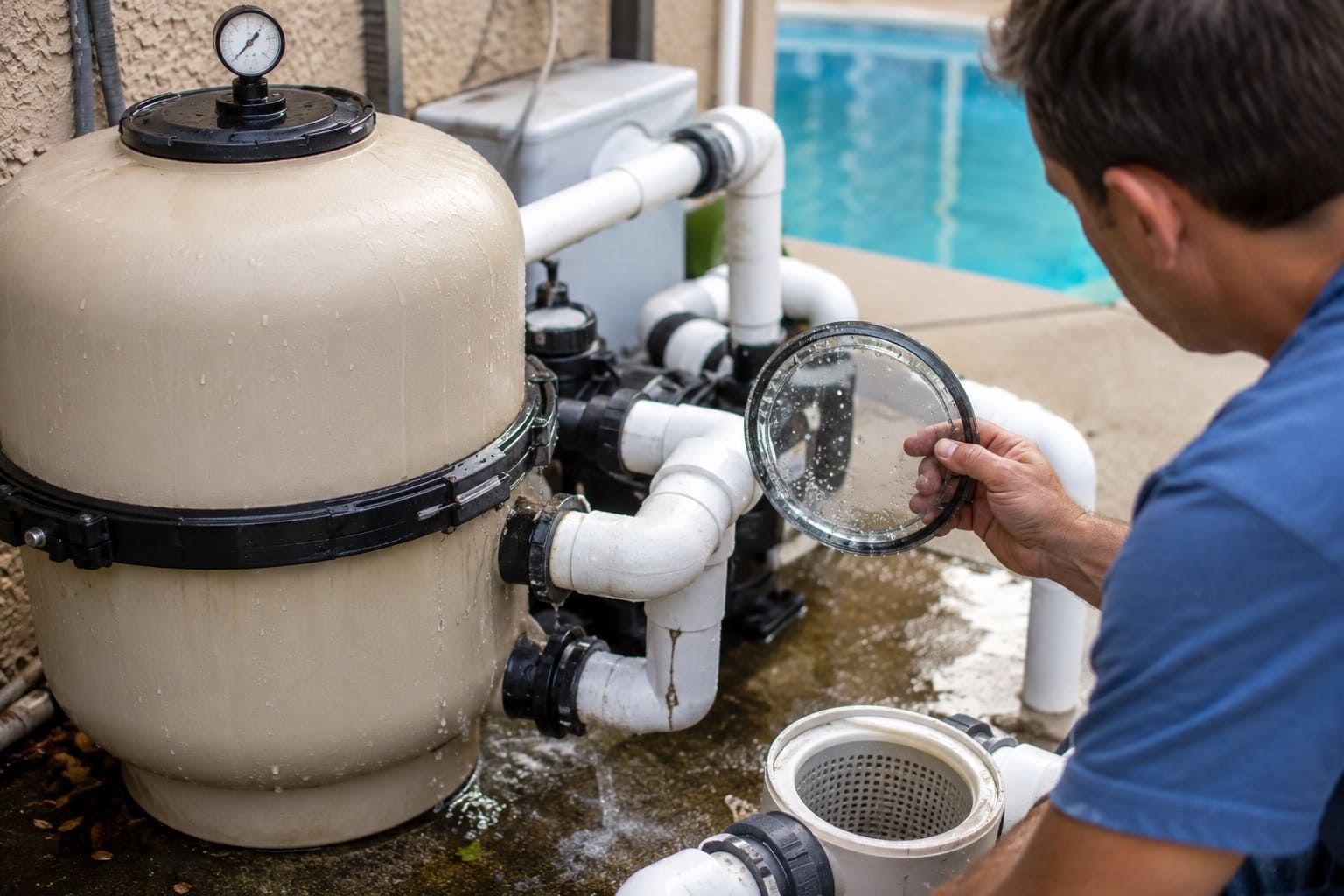
High Pool Filter Pressure problems often show up as rising pressure, weaker return flow, cloudy water or a leak around the equipment pad. None of these symptoms automatically means the entire filter has failed.
A dirty cartridge, restricted media, suction-side air leak, incorrectly positioned valve, worn seal or faulty pressure gauge can produce similar symptoms. The most useful diagnosis comes from looking at pressure, water flow and pump behaviour together.
As a practical guide:
- High pressure with weak return flow usually suggests increasing resistance through the filter or somewhere on the return side.
- Low or unstable pressure with weak flow can point toward the skimmer, suction plumbing, pump basket, air entering the system or a pump problem.
- Water around a gauge, union, valve or seal may indicate a repairable component.
- A cracked filter vessel or a leak associated with the lid or clamp area requires the system to be switched off and assessed before further operation.
Start With Safety: A Pool Filter Is a Pressurised Vessel
A High Pool Filter Pressure should never be opened while the circulation system is pressurised.
Before removing a cartridge filter lid, opening a filter housing or servicing pressure-retaining components, switch off the pump and any automatic controls that could restart it. Open the manual air-relief valve where fitted and confirm that system pressure has been fully released.
Do not loosen or tighten a filter clamp, lock ring or lid mechanism while the pump is running or while pressure remains inside the vessel.
If water is escaping from a cracked tank, damaged lid or clamp area, stop operating the system until the filter has been inspected. These faults should be treated differently from a minor drip at a gauge, drain plug or threaded fitting.
What Filter Pressure Actually Tells You
The pressure gauge measures resistance within the circulation system. It does not directly measure how clean the pool is.
The pump draws water through the skimmer and other suction points, pushes it through the filter and sends it back to the pool through the return lines. As contamination accumulates inside the filter, resistance normally increases.
There is no universal pressure reading that every residential pool should operate at. Normal pressure depends on factors such as:
- pump performance;
- pipe diameter and layout;
- filter type and size;
- valve position;
- heaters and other equipment in the return line;
- the overall hydraulic design of the system.
The most useful number is therefore the pressure recorded when the filter is clean and the system is operating correctly.
That clean-filter reading gives you a baseline against which future changes can be compared.
A Quick Symptom Guide
| Symptom | Likely area to investigate | First check |
|---|---|---|
| High pressure and weak returns | Filter or return-side restriction | Clean or backwash the filter and check valve positions |
| Low pressure and weak returns | Suction side or pump | Check water level, baskets, priming and air leaks |
| Gauge does not return to zero | Pressure gauge | Relieve system pressure and inspect or replace the gauge |
| Water around gauge or union | Fitting, thread or seal | Shut down the system and inspect the leaking component |
| Water near lid or clamp | Lid seal, clamp or vessel | Stop the pump and release pressure before assessment |
| Filter media entering the pool | Internal media-filter components | Inspect laterals and internal assembly |
| Pressure rises again quickly after cleaning | Persistent restriction or filter problem | Check filter condition, valves and circulation path |
The table is a starting point rather than a substitute for diagnosis. Several faults can occur at the same time, especially on older equipment pads.
High Pressure Does Not Automatically Mean the Filter Has Failed
A gradual rise in pressure commonly occurs as the filter captures debris.
For a cartridge filter, contamination builds between the pleats. In a sand or glass-media filter, accumulated material increases resistance through the media bed.
Other conditions can also create high pressure.
A return valve that is partially closed, a restriction further along the return plumbing or an incorrectly configured bypass can increase resistance after the filter.
That is why replacing the filter solely because the gauge reads higher than expected can be a costly mistake.
Pressure should be interpreted alongside return strength, pump behaviour and valve position.
Clean or Backwash the Filter First
If pressure has risen gradually and circulation has weakened, routine filter maintenance is the logical first check.
Cartridge filters
Switch the system off, relieve pressure fully and then open the filter according to the manufacturer’s instructions.
Remove the cartridge elements and inspect them while cleaning. Look for:
- debris embedded between the pleats;
- flattened or distorted pleats;
- tears in the filter fabric;
- cracked end caps;
- damaged internal supports;
- unusually heavy oil or sunscreen contamination.
A cartridge can look reasonably clean on the surface while remaining restricted deeper within the pleated material.
After cleaning and correct reassembly, restart the system according to the manufacturer’s procedure and compare the new pressure reading with the normal clean-filter baseline.
Sand and glass-media filters
Backwash according to the filter manufacturer’s operating instructions.
For many systems, backwashing continues until the discharge water or sight glass runs clear, followed by the specified RINSE cycle before the multiport valve is returned to FILTER.
The exact procedure and duration depend on the filter model.
Always switch the pump off before changing the position of a multiport valve.
Operating the valve while water is moving through it can damage internal valve components.
If pressure remains unusually high after correct cleaning or backwashing, the problem needs further investigation.
Weak Return Flow May Begin Before the Filter
Low flow at the High Pool Filter Pressure returns is not automatically a filter fault.
A restriction on the suction side reduces the amount of water reaching the pump. Common causes include:
- a blocked skimmer basket;
- a full pump basket;
- low High Pool Filter Pressurewater level;
- debris restricting a suction line;
- a poorly sealed pump lid;
- a deteriorated pump-lid O-ring;
- air entering through a suction-side fitting;
- a pump that is not priming correctly.
These faults often produce weak circulation without the high filter pressure expected from a severe pressure-side restriction.
Looking through the clear pump lid can provide useful clues. A pump basket that remains full of water is normal for many systems. Persistent air, surging water or repeated loss of prime deserves further investigation.
Check the Pressure Gauge Properly
High Pool Filter Pressure gauges are simple mechanical components and do fail.
A useful basic check is what happens after shutdown.
When the pump has been switched off and system pressure has been fully relieved, the gauge should normally return to zero. If the needle remains significantly above zero, the gauge may be faulty.
A damaged gauge can send diagnosis in the wrong direction, especially if decisions are being made solely from the displayed pressure.
The gauge should therefore be checked before major equipment is condemned.
Leaks Can Come From Repairable Components
Water around a filter does not always mean the pressure vessel itself is damaged.
Potential leak points include:
- pressure gauge connections;
- manual air-relief assemblies;
- drain plugs;
- unions;
- threaded fittings;
- valve connections;
- lid O-rings;
- multiport valves.
The exact location matters.
A drip from a threaded gauge fitting is a very different problem from a crack in the filter tank.
Homeowners should also avoid repeatedly tightening plastic fittings in an attempt to stop a leak. Excessive force can damage threads, distort seals or crack ageing plastic components.
Persistent pressure faults, valve leaks or water loss may justify professional pool filter repair before the entire filter is replaced. The key question is whether the problem is confined to a serviceable part or involves the pressure vessel or another component that is no longer practical to repair.
Cartridge Filters Have Several Possible Failure Points
The cartridge itself is only one part of a cartridge-filter system.
Pleated elements can gradually become restricted by fine dust, body oils, sunscreen residue and other contaminants. Repeated cleaning also eventually takes a toll on the filter fabric.
Damaged cartridges may show:
- torn material;
- collapsed pleats;
- deformation;
- cracked end sections;
- loss of structural rigidity.
The housing and sealing components also require inspection.
A damaged O-ring can cause water leakage or make the filter difficult to seal correctly. Air-relief components, pressure gauges and locking mechanisms can also deteriorate independently of the tank.
If the vessel remains sound and correctly sized for the High Pool Filter Pressure replacing cartridges, seals or other service components may restore normal filtration without replacing the whole unit.
Sand and Glass-Media Filters Fail Differently
Media filters have internal components that are not visible during normal operation.
Water passes through the media before travelling through internal collectors and back toward the High Pool Filter Pressure. Problems can develop in the valve, internal pipework or laterals even when the external tank appears normal.
One recognisable symptom is filtration media appearing on the pool floor near the return jets. This can indicate damage to laterals or another internal component, although the system should be inspected before assuming a specific failure.
A worn multiport valve can create other problems, including:
- water continuing toward the waste line;
- difficulty selecting operating modes;
- leakage around the valve;
- unintended bypassing of the normal filtration path.
Filter media should not be replaced simply because it has reached an arbitrary age. Filtration performance, contamination, channeling, internal condition and manufacturer guidance provide a better basis for deciding whether media service is required.
Valve Position Can Change the Whole System
Residential pool equipment pads often contain several valves controlling different parts of the circulation system.
These may include:
- skimmers;
- suction cleaners;
- main drains;
- heaters;
- solar systems;
- spa circuits;
- water features;
- different return zones.
A valve that has been moved during maintenance and not returned to the correct position can dramatically alter flow.
Before assuming that a pump or filter has failed, check that manual valves are in their normal operating positions.
Where a multiport valve is fitted, stop the pump before moving the handle to another setting.
Do Not Ignore Equipment Further Downstream
The filtration system may also include a chlorinator, heater, heat pump or other flow-dependent equipment.
A severe filter or plumbing restriction reduces system flow. That reduced flow may prevent downstream equipment from operating correctly or may trigger its low-flow protection.
For example, a heating unit that repeatedly refuses to operate may be responding to inadequate water flow rather than suffering from an internal heating fault.
This is another reason to assess the complete circulation path rather than replacing individual components in isolation.
When Filter Replacement Makes More Sense
Repair is worthwhile only while the underlying equipment remains safe and serviceable.
Replacement becomes more appropriate when the filter has problems such as:
- a structurally damaged pressure vessel;
- significant cracking or deterioration;
- unavailable critical replacement parts;
- repeated failures across several major components;
- substantial undersizing for the pool and pump combination;
- an installation that no longer suits the surrounding equipment.
An undersized filter can require unusually frequent cleaning or backwashing because its effective filtration area is too small for the debris load and operating conditions.
If the pump or other major equipment has previously been changed, it is also worth checking whether the existing filter still suits the hydraulic system.
The best repair-versus-replacement decision considers the fault itself, filter capacity, equipment condition, parts availability and likely remaining service life.
Check the Pump Before Buying a New Filter
The pump and filter operate as one circulation system, so symptoms often overlap.
Before replacing either component, check the basics:
- pool water level is adequate;
- skimmer baskets are clear;
- the pump basket is clean;
- the pump lid is correctly sealed;
- there is no persistent air entering the pump;
- valves are correctly positioned;
- the filter has been cleaned or backwashed properly;
- the pressure gauge behaves normally;
- return flow is reasonably consistent;
- there are no unexplained leaks around the equipment pad.
If these checks do not identify the problem, pressure and flow behaviour can be used to narrow the diagnosis further.
Why Diagnosis Before Replacement Matters
Replacing the wrong component does not remove the original restriction.
A new filter will not repair a suction leak. A new pump will not correct a closed return valve. Fresh filter media will not fix damaged internal plumbing.
The useful question is:
Where is water flow being restricted, lost or redirected?
Once the problem is located on the suction side, within the pump, through the filter or on the return side, the repair decision becomes much more specific.
That can mean cleaning rather than replacing, changing a seal instead of an entire filter, repairing a valve or investigating another component altogether.
Learn the Normal Behaviour of Your Pool System
A homeowner does not need to dismantle equipment regularly to notice developing problems.
A few baseline observations are often enough:
- note the normal pressure immediately after filter cleaning;
- notice the usual strength of the return jets;
- check whether the pump basket normally runs free of persistent air;
- look periodically for drips around valves, unions and the filter;
- pay attention if cleaning intervals suddenly become much shorter.
Changes from the pool’s normal behaviour are often more informative than a pressure number viewed on its own.
Repair, Maintenance or Replacement?
High pressure, low flow and equipment-pad leaks are symptoms, not diagnoses.
A filter that is simply loaded with debris may need routine cleaning. A filter with a worn gauge, leaking seal or faulty valve may be repairable. A cracked or seriously deteriorated pressure vessel is a different matter and should not continue operating until properly assessed.
The most reliable approach is to evaluate the entire circulation path and determine what has actually changed.
Doing that before purchasing new equipment can prevent unnecessary replacement while identifying faults that genuinely require professional attention.
